Updated October 2026
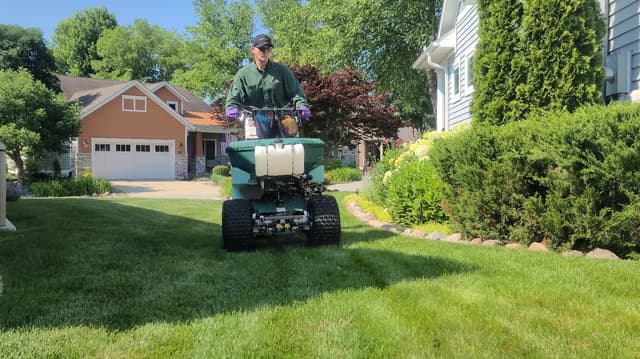
Neither is better for every route. Electric is the better fit when your day starts early, ends at a place with a charger, or you want to stop buying oil, plugs, and clutch service. Gas is the better fit when you work long days far from power and need to refuel anywhere. PermaGreen builds both on the same machine: the gas Triumph and the battery-electric Legacy.
Electric vs gas ride-on spreader sprayer: which is better for lawn care routes?
Choose by route, not by preference. Four things decide it: where the machine spends its day, what time you start, how much shop time goes to engine maintenance, and whether your crew can charge a battery between routes.
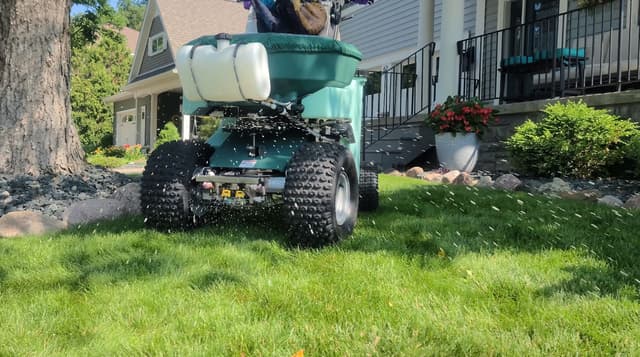
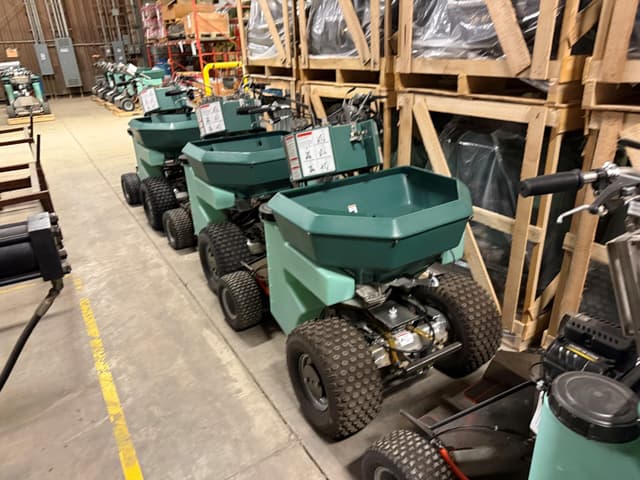
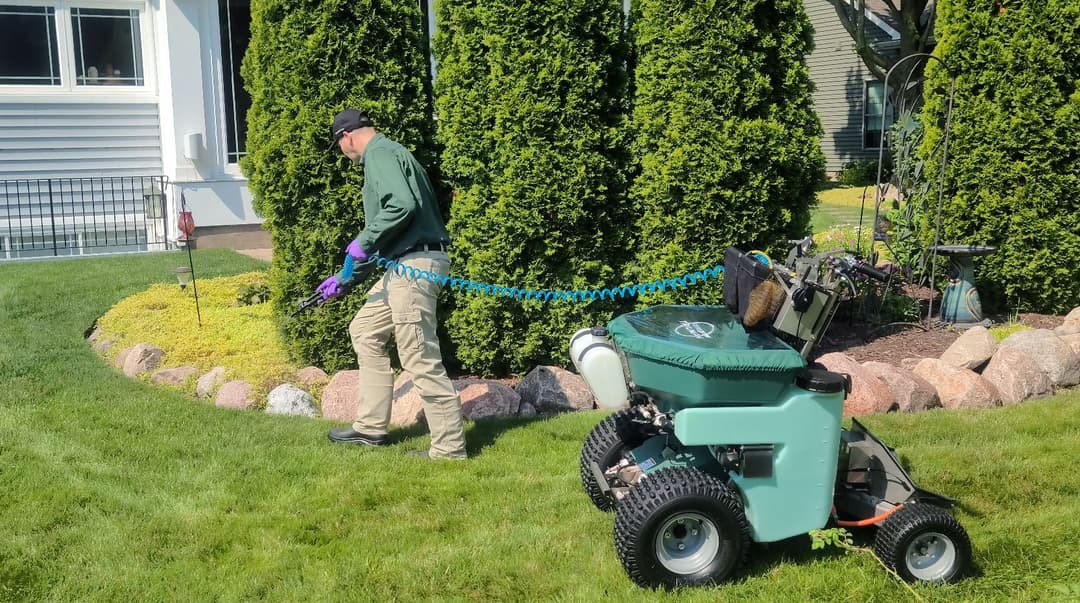
PermaGreen's Legacy is the Triumph with a swappable 48-volt battery and electric motor in place of the gasoline engine and the oil-bath wet clutch. Everything else is shared: the 150-pound hopper, the 12-gallon tank, the one-acre coverage, the 35.5-inch width that clears a standard yard gate, and the spread-and-spray system. Both top out at 5 mph with a two-speed transaxle and reverse.
The table below uses PermaGreen's own side-by-side rows for the two machines.
| Criterion | Legacy (battery-electric) | Triumph (gas) | Edge |
|---|---|---|---|
| Power source | Swappable 48V battery | Honda or Vanguard gas engine | Depends on route |
| Refueling | Swap in a charged pack | Gas cans and fill-ups | Depends on route |
| Engine oil | None, no oil changes | Routine oil changes | Electric |
| Clutch | Belt drive, no wet clutch | Oil-bath wet clutch | Electric |
| Tune-up parts | No plugs, filter, or carburetor | Plugs, air filter, carburetor | Electric |
| Sound | Quiet enough for early starts | Gas-engine noise | Electric |
| Emissions | Zero at the machine | Engine exhaust | Electric |
| Hopper, tank & coverage | Identical | Identical | Tie |
| Spread & spray system | Identical | Identical | Tie |
PermaGreen's own table marks the Legacy ahead on refueling because a charged pack swaps in without gas cans. We list it as "depends on route" because that only holds if you have somewhere to charge.
Is there a quiet spreader sprayer for early-morning applications?
Yes. The electric Legacy is built for it. An electric motor runs without the noise of a gasoline engine, which PermaGreen describes as making early-morning starts and noise-sensitive properties far easier to service. The Legacy is also described as considerably quieter than the gas Triumph.
Where this matters on a commercial route:
- Early starts. PermaGreen describes the Legacy as making early-morning starts far easier to service.
- Noise-sensitive properties. The same comparison names noise-sensitive properties as the other place the quieter motor pays off.
- Crew comfort. The Legacy has zero emissions at the machine, so there is no exhaust for the operator to breathe.
PermaGreen does not publish a decibel rating on the Legacy page, so we do not quote one. If sound limits are a contract requirement, ask us before you rely on it, and check local ordinance hours, which set the earliest legal start however quiet the machine is.
There is a regulatory angle too. PermaGreen's California comparison notes that the state is phasing out gas-powered commercial equipment, citing a CARB zero-emission small-engine action, and points those operators to the Legacy.
Which ride-on spreader sprayers run without gasoline or oil changes?
The PermaGreen Legacy does. It spends nothing on fuel, has no engine oil to change, and has no oil-bath wet clutch to service. The motor drives the transaxle and pump through a simple belt-and-pulley system, so there are fewer parts that wear.
What disappears when you go electric:
- Gasoline. No fuel, no stabilizer, no cans to haul or store. The Legacy charges from a standard outlet overnight.
- Engine oil. An electric motor needs no crankcase oil.
- Clutch service. With no oil-bath wet clutch, that service goes away too.
- Tune-up parts. No spark plugs, air filter, or carburetor to clean, replace, or troubleshoot when the season gets busy.
What stays the same: the hopper, tank, coverage rate, frame, and the spread-and-spray system. You are changing the power plant, not how product gets on the turf.
The battery, in numbers
The Legacy runs on a sealed lithium-ion 48-volt pack. The figures PermaGreen publishes are:
- 3.2 kWh of onboard energy (62 Ah at 51.7 V nominal)
- IP67 sealing, described as dust-tight and washdown-ready
- 2,000 charge cycles, rated at 80% depth of discharge
- 42 lb pack weight, lifted out with a patent-pending release
- About 3 hours to recharge at the pack's rated 17 A charge current
- UL 2271 certified, plus UL 2580, UN 38.3, and CE
PermaGreen publishes no runtime-per-charge figure on the Legacy page. Ask us for current runtime data for your route before you decide how many spare packs you need.
When is gas still the right choice?
Gas is still right when your machine works long days far from any power source. A gas engine refuels from a can and keeps going, with no dependence on a charger or spare packs.
PermaGreen's published fuel figure is that one gallon lasts 4+ hours of operation. The gas Triumph comes with a choice of a Honda GX200 5.5 HP engine or a Vanguard 6.5 HP engine. Gas is the sensible pick when:
- Your route runs far from outlets and the machine is away from power all day.
- You have no charging location. A machine stored somewhere without an outlet cannot charge overnight.
- Your fleet is already gas. Crews that carry fuel and run an oil-change routine can drop the gas Triumph straight in.
The cost of that flexibility is the maintenance list. The Triumph's table rows are routine oil changes, an oil-bath wet clutch, and plugs, an air filter, and a carburetor. It is a routine most crews know, and it is still time and parts the Legacy removes.
Decision checklist for your routes
| Ask this | If yes, lean |
|---|---|
| Do you start before most neighbors are awake, or service noise-sensitive sites? | Electric |
| Does the machine return to a place with a standard outlet every night? | Electric |
| Is engine-oil, clutch, or tune-up labor a real line in your shop's week? | Electric |
| Does your crew need zero exhaust at the machine? | Electric |
| Do full days run far from any power source with no way to swap or charge? | Gas |
| Is your fleet, parts stock, and training already built around gas engines? | Gas |
| Do you need to refuel from a can in the field with no planning? | Gas |
A mixed fleet is reasonable. Because the two machines share the hopper, tank, and spread-and-spray system, you can run the Legacy on early and noise-sensitive routes and a gas Triumph on long days away from power.
See the specs page for the full Triumph specification.
Bottom line
Pick electric when quiet starts, no engine oil, no wet clutch, and zero emissions at the machine matter more than the ability to refuel anywhere. Pick gas when you work long days away from power and want the simplest possible refueling. The hopper, tank, coverage, and spread-and-spray system are identical either way, so you are choosing a power plant, not a different machine.
Next step. Learn about the battery-electric machine on the Legacy page, where the Configure button starts your quote, or read about the gas machine on the Triumph page. To configure a Triumph and see today's factory-direct price and financing, use the configurator. Every PermaGreen comes with free shipping within the continental US and a 60-day buy-back guarantee: run it on your own routes, and if it does not earn its keep, PermaGreen buys it back for a full refund and covers return shipping.