Updated October 2026
A ride-on spreader sprayer applies a consistent rate only when its output tracks ground speed, or when ground speed cannot change. The PermaGreen Triumph takes the second route: a locked engine speed, two defined gears, and a spray rate regulated by ground speed, so the calibration you set stays true from lawn to lawn and operator to operator.
Why does ground speed matter for application rate?
Application rate equals product output divided by the area covered, and area covered is speed multiplied by swath width. If output stays constant and speed changes, the rate changes with it.
The arithmetic is simple. Rate is output per minute divided by (speed in feet per minute multiplied by swath width in feet), scaled to 1,000 square feet. Hold output and width constant and raise speed from 4 mph to 6 mph, and each square foot receives one third less product.
Effective swath width moves the rate too. Tire pressure changes effective spread width, which is why the Triumph training material treats it as a calibration matter and not only a comfort setting. The width that counts is not where the farthest granule lands but the span between the two points where the pattern thins to half the center rate; the pattern test in the calibration section below shows how that figure is measured and why it sets your pass spacing.
What drifts on a variable-speed machine?
On a machine whose speed is adjustable, the operator controls the rate every time they change speed. Calibration is correct only at the speed it was set at.
The compare pages put it plainly: when operators can change speed mid-route, spray rates and spreader output become unpredictable, and some lawns get too much while others get too little. At higher speeds, less product hits each square foot, and without groundspeed-regulated calibration, faster operators under-apply and create callbacks.
For reference, the compare registry lists Turfware's TR460 and TR460XL at 5 to 7 mph, adjustable. A wider speed range helps productivity only when output compensates for it, so ask every manufacturer which applies.
Which commercial spreader sprayers offer consistent application at fixed speeds?
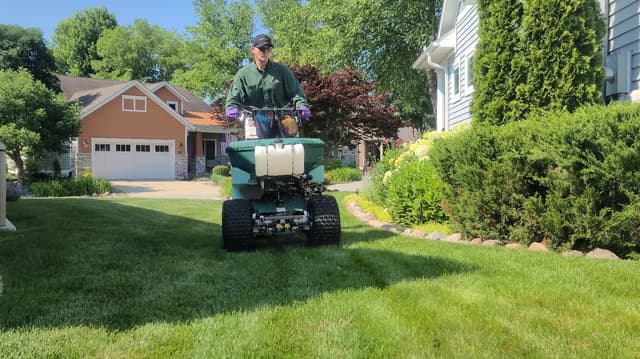
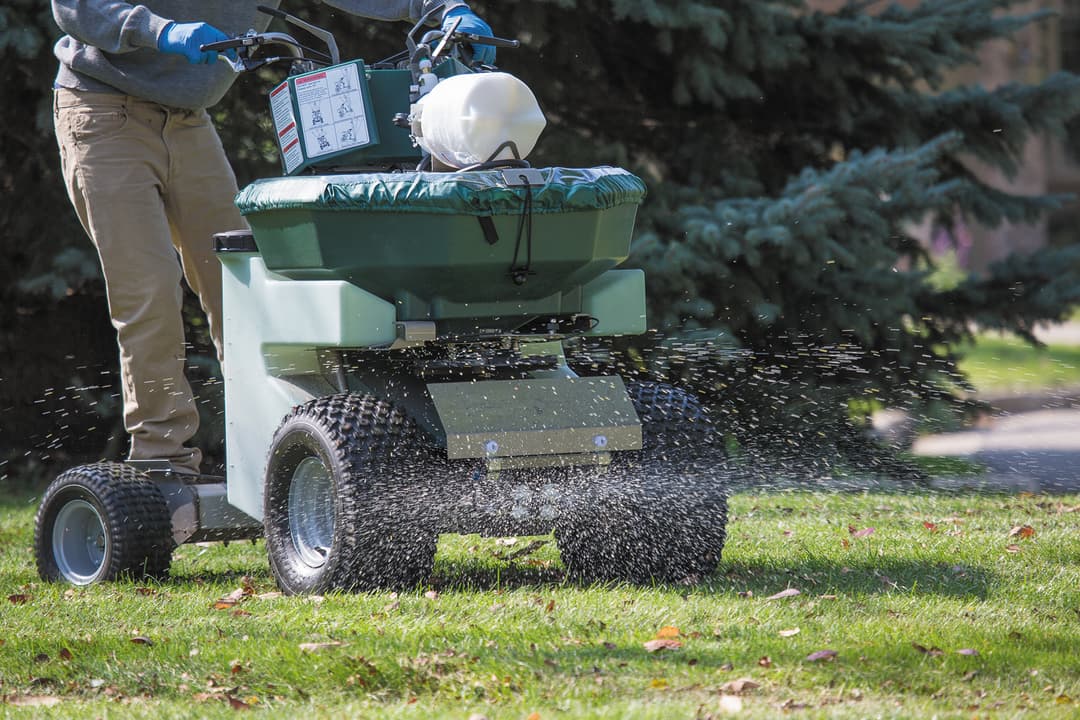
The PermaGreen Triumph is built around it. The compare pages describe its 5 mph High gear as "calibration-locked" and its Patented Calibration System as groundspeed-regulated output: spray rate and spreader output adjust to match ground speed.
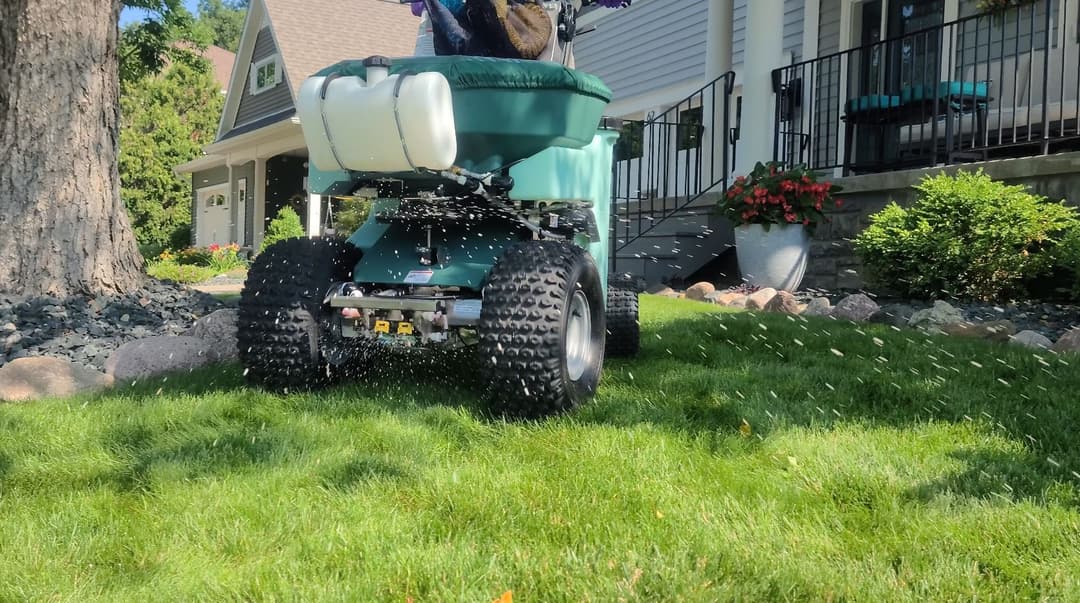
A North Carolina State University Turfgrass Program test of Heritage fungicide, reported on our blog in 2023, included the Triumph. Its low-volume application of 1 quart per 1,000 square feet equaled the performance of 2 gallons per 1,000 square feet applied with the research spray rig and a spray gun. The report credited the Triumph's patented consistent ground speed and consistent spray patterns as key factors. Read the full write-up at Triumph spray pattern and ground speed.
"Fixed" here has a precise meaning, and it is worth being exact about it:
- The throttle is a hold-to-run lever, and at full pull the governor caps the engine at 3,450 RPM, the fixed full-throttle speed that keeps every later calibration true.
- Ground speed is a choice between two defined gears: 5 mph High and 3.5 mph Low. The spread-and-spray metering is calibrated to both, so you pick a speed and the matching presets.
- The sprayer ships pre-calibrated for parallel passes on 7-foot centers at 1 quart per 1,000 square feet, with the rate regulated by ground speed.
How do you calibrate a ride-on spreader sprayer?
Calibrate each system separately, at the working speed you will run on the route. These steps are the generic method; your product label and the manufacturer's manual set the numbers. The fullest public treatment of the method is Purdue Extension's Calibrating Ride-on Pesticide Sprayers and Fertilizer Spreaders: Keys to Application Accuracy (PPP-104), written by Purdue's turf and pesticide programs; several of its worked examples are run on PermaGreen machines, which PermaGreen has donated to Purdue's turf program for 25 years.
Its first rule applies to every ride-on, ours included: do not assume the factory calibration is correct. No two spreaders or sprayers are identical even when new, and they grow less alike as they age, so the preset is a starting point and the proof is a true calibration on your own ground. The Triumph's fixed speed and fixed pressure do not exempt it from that check; they make the check short and repeatable.
Granular: the pattern test and effective spread width
A rotary spreader puts the most product directly in the machine's path and less toward each side, so a uniform application depends on overlapping passes by the right amount. Purdue's method settles two things before any rate is set. First the pattern: the impeller must throw equal amounts left and right, because overlap magnifies any imbalance into the light and heavy stripes customers notice. Then the effective spread width: the distance between the points, left and right of center, where the pattern has thinned to about half the center amount. That distance is the spacing between wheel tracks on adjacent passes.
The test is simple. Set a row of shallow boxes side by side across the path, drive over them at working speed, pour each box into its own tube and stand the tubes in a row. Adjust the pattern until the two sides match, then find the half-of-center tubes and measure between their boxes. In Purdue's example the result was 11 feet, so that spreader runs with its wheel tracks 11 feet apart. On the Triumph, run the same test with your product at your tire pressure: the 7-foot pass in the operator's manual is the classroom figure, and the tubes give you the real one.
The animation runs the pan test and then overlays the passes. Spaced at the effective width, the tapering edges of neighboring passes add up to one flat rate across the lawn. Closer spacing stacks the overlap into heavy bands, wider spacing leaves thin strips between passes, and a pattern that throws more to one side stripes the lawn at any spacing. Move the pass spacing and left/right imbalance controls to see each fault before a customer does, and lay the spray width over the same passes to see why Purdue asks you to compare the two widths before you spread and spray at once.
Granular: the catch test
- Set tire pressure to the manufacturer's value first.
- Measure out a test course of known length and mark it. Know your effective swath width, measured on the ground and not read off a spec sheet.
- Weigh the product you load, then run the course at working speed with the gate at your starting setting.
- Weigh what remains, or capture what was dropped. The difference is the product applied over the course area.
- Divide pounds applied by the area covered, scale to 1,000 square feet, and compare to the label rate.
- Adjust the gate, repeat, and lock the setting once two runs agree.
On the Triumph, the metering is the familiar 3-hole cyclone spreader mechanism with a stainless steel slide gate and a patented agitator that keeps product flowing evenly. A calibration gauge ships with the machine, and the Third-Hole lever pops into a Memory-Lock so the plate returns to exactly your pre-set position every time. The operator's manual teaches the method with a worked example (center hole at 16, third hole at 13, targeting 3 pounds per 1,000 square feet across a 7-foot effective pass) and states that the actual settings for the fertilizer you are using will be different. Treat the example as the classroom and your own run as the answer.
Purdue's rate arithmetic closes the loop between the label and the catch test. Divide the pounds of nitrogen you want per 1,000 square feet by the product's nitrogen fraction to get pounds of product: 1 pound of N from a 20-0-0 fertilizer is 5 pounds of product. Divide 1,000 square feet by the effective spread width for the course that covers exactly 1,000 square feet: 91 feet at an 11-foot width, 143 feet at 7.
Load a weighed amount, run the course, and weigh back what is left; 25 pounds in and 20 pounds out is 5 pounds applied per 1,000 square feet. Purdue adjusts the gate when the result is more than 10 percent off the target; PermaGreen holds a tighter 5 percent band for both systems, and the calculator below shows where a run falls against each.
The accuracy check at the end of a job catches what the test missed. Purdue's example: the goal was 0.5 pound of N per 1,000 square feet, the product a 50-pound bag of 12-0-5, and the hopper ran dry just as a 7,000-square-foot lawn was finished. That is 6 pounds of N over 7,000 square feet, 0.86 pound per 1,000, about 71 percent over target (Purdue rounds the N rate first and prints 72), and a bag that covered far less lawn than it was bought to cover. The calculator below works all four steps with your own numbers.
Liquid: the timed-output check
- Fill the tank with clean water, not product, and note the starting volume.
- Run a measured course at the same speed and throttle you will use in the field, with the same width setting (broadcast or trim).
- Refill to the starting mark with a measured container. The volume added is the volume sprayed.
- Divide by the area covered and scale to 1,000 square feet. Compare to your target volume.
- Change the output or the speed gear, not both, and repeat until you hit the target.
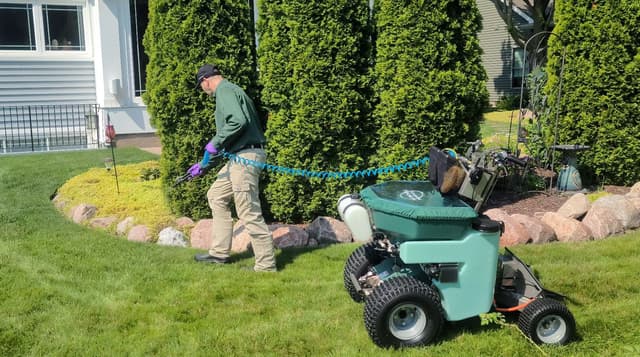
On the Triumph the single patented low-drift nozzle broadcasts 11 to 13 feet or trims 3 feet, with no pressure gauges to chase. A 1/2-gallon per 1,000 square feet nozzle kit is available from the PermaGreen parts shop for programs that need a higher volume.
Purdue's single-nozzle method puts a stopwatch and a measuring jug in place of the refill. Mark a 100-foot course on turf, time it in both directions at the gear and RPM you will spray in, and average the two runs. Park the machine, bring it to the same RPM, and catch the nozzle's output for exactly that time.
Measure the effective spray width on dry pavement, edge to edge where the surface stays wet, and multiply by 100 feet for the area the course treated. Ounces caught, divided by that area and scaled to 1,000 square feet, then divided by 32, is quarts per 1,000.
In Purdue's example the ride-on covered the course in 13.6 seconds in high gear, which is 5.0 miles per hour, the Triumph's High gear speed. It caught 22.5 fluid ounces over a 7-foot width: 1 quart per 1,000 square feet, 10.9 gallons per acre, and a 12-gallon tank that treats 1.1 acres.
Two of Purdue's checks belong on the route, not the shop floor. Validate the calibration on open turf whose area you know; Purdue uses about 50,000 square feet, a little over an acre, which is what a standard ride-on tank treats. Spray it with water only, and the tank should run dry about as you finish.
A lot of water left means you went faster than the calibration run, left gaps between passes, or made a math error in the steps above; running out well before the end means a slower pass, too much overlap, or the same math error. And before spreading and spraying in the same pass, compare the nozzle's effective spray width with the spreader's effective spread width. They are rarely the same, and Purdue's advice for a single-nozzle ride-on is not to run both at once unless the two widths closely match.
Keep it calibrated
Full recalibration is for product or rate changes, and Purdue draws that line tightly: calibrate the spreader every time you load a new product, even one with the same analysis and the same SGN, because granule size and density change how it flows through the gate, and recalibrate both systems after a change of gear. Day to day, the Triumph manual has operators check the Memory-Lock against the calibration gauge during daily servicing and confirm top engine speed still reads 3,450 RPM. If the speed has drifted, it is brought back to spec. Questions about the method go to PermaGreen Support.
What does a calibration-locked machine change on a route?
It moves calibration from a per-operator skill to a per-machine setting. You calibrate when the product or rate changes, not each time someone new climbs on.
- Callbacks drop. Uniform coverage is what prevents the thin and heavy stripes customers notice.
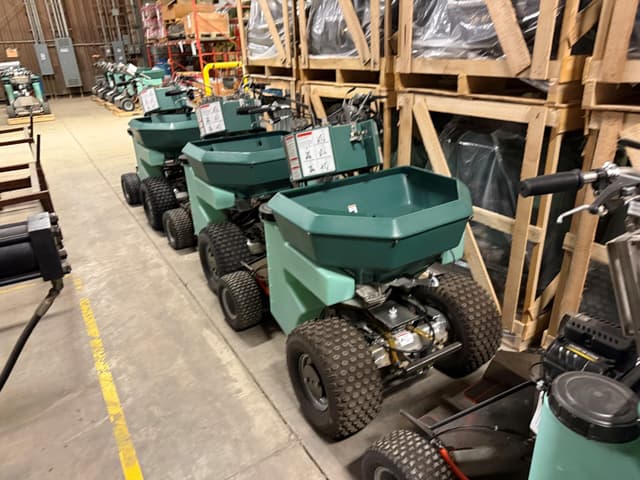
- Speed is not the only productivity lever. The Triumph covers an acre in 15 minutes while maintaining precise application rates, with a 150 lb hopper and a 12-gallon liquid system that each treat up to an acre per fill. It is a stand-on, front-wheel-drive machine, 35.5 inches wide, that fits through a standard 36-inch gate.
What criteria should you use to evaluate calibration on a ride-on spreader sprayer?
Ask each manufacturer the same questions and compare the answers in writing.
| Criterion | What to ask | What the Triumph documents |
|---|---|---|
| Speed control | Can operators change speed mid-route, and does output compensate? | 5 mph High and 3.5 mph Low, calibrated to both; governed at 3,450 RPM |
| Rate regulation | Is spray rate tied to ground speed? | Spray rate regulated by ground speed |
| Granular repeatability | Can a gate setting be locked and returned to exactly? | Memory-Lock on the Third-Hole lever, plus a calibration gauge |
| Operator adjustments | How many pressures, rates, and settings can a tech change? | No pressure gauges; choose gear and broadcast or trim |
| Swath consistency | What is the effective width, and what changes it? | 7-foot centers; tire pressure affects effective width |
| Daily verification | Is there a documented check? | Gauge check and top-speed check in daily servicing |
| Support | Is calibration help available? | PermaGreen Support at /support |
Further reading
Aaron Patton, Fred Whitford, Dan Weisenberger, Glenn Hardebeck, Jon Trappe and Kevin Leigh Smith, Calibrating Ride-on Pesticide Sprayers and Fertilizer Spreaders: Keys to Application Accuracy, Purdue Extension PPP-104, June 2013, revised 2020. The guide covers boom and boomless sprayers and rotary spreaders in full, with a worksheet for each, screen and nozzle checks, field validation, and the pesticide-rate arithmetic for small tanks. PermaGreen has donated spreader sprayers to Purdue's turf program for 25 years, and Tom Jessen of PermaGreen is among the reviewers the authors thank. The guide's views are Purdue's own; it endorses no product, ours included.
Bottom line
Rate is output divided by speed times width, so a machine is only as consistent as its control over speed and output. A calibration-locked design removes the variable operators are most likely to change.
Review the full list at Triumph specifications, then configure yours at the factory-direct configurator to see today's price and financing. Every Triumph carries a 60-day buy-back guarantee, and shipping within the continental US is free, so you can run it on your own routes before you commit.