Part 2 of 5 in the Modernizing Your Lawn Care Business series. Updated October 2026.
Part 1 of this series looked at the time and labor that pushing spreaders and pulling hoses cost. This part turns that into arithmetic you can run on your own business. Labor rates, route density and lawn sizes differ too much from one business to the next for a sample cost per property to stand in for yours, so every number below is a figure PermaGreen publishes, one you supply, or a labelled example for you to replace.
How do you work out your cost per property?
Start with one ordinary day on one route. Add up what the day costs: wages and payroll costs for everyone on the route, fuel, and equipment upkeep. Divide that by the number of properties the route finished that day. The result is your cost per property, before product, overhead and profit.
Product is left out on purpose. If both methods hold the label rate, a lawn takes the same amount of fertilizer or herbicide whichever machine puts it down, so product cost does not change the comparison.
Two numbers move the result: what the day costs, and how many properties fit into it. To see where the time goes, time each part of every stop for one full round: applying on the lawn, setting up and refilling, and driving to the next stop. Only the first two depend on the equipment.
How fast does the Triumph apply?
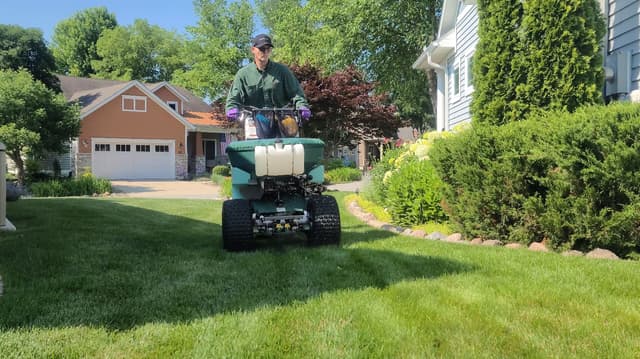
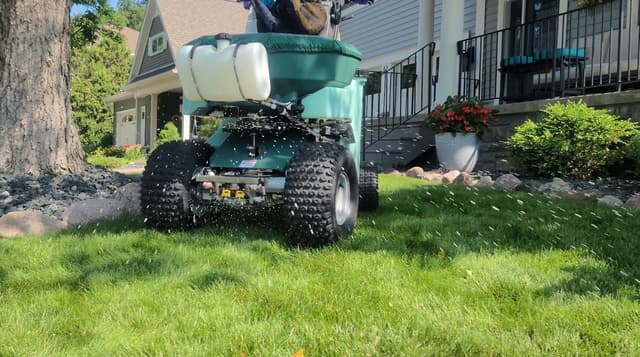
PermaGreen's product FAQ puts the Triumph at about 4 acres per hour, or one acre in 15 minutes. The 150-lb hopper holds three bags and the 12-gallon liquid system holds two 6-gallon tanks, and each treats up to an acre per fill, which PermaGreen says means fewer trips to refill. The same FAQ says most operators treat 10 or more additional lawns per day compared with walk-behind equipment.
Compare those figures with the times you recorded, not with a sample route. How many extra lawns you finish depends on route density, property size and product mix.
How fast could extra lawns pay for a machine?
If a machine adds lawns to each day, the added gross profit from those lawns is what pays for it. The calculator below starts at PermaGreen's published figure of 10 additional lawns per day. Change it to your own estimate, and replace the example revenue per lawn, gross margin and season length with your own numbers. Prices change, so the calculator links to the build page for today's price.
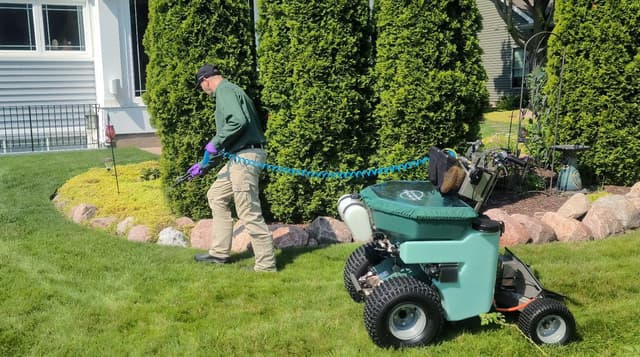
Fewer people on a route is the other way to lower the cost of a day. How many people a route needs depends on its properties and the work at each stop, so test any change in crew size on your own routes rather than assuming it.
How do you check the numbers on your own routes?
Run one machine on one route for a full application round and record what you recorded before: properties finished per day, time per stop, and trips back to the truck. Put your own count into the calculator in place of the published figure.
The Triumph carries a 60-day buy-back guarantee: if you are not completely satisfied within the first 60 days, PermaGreen buys it back for a full refund and covers the return shipping.
What comes next in the series?
Part 3 looks at the labor side: how hard field crews are to keep, and what a ride-on spreader sprayer changes for the person running the route. For the machine itself, see the full specifications on the Triumph specs page, or configure one and see today's factory-direct price on the build page. To talk it through, call PermaGreen at (866) 883-3456.